Sadfire
Miraculously John Martyn survived the mayhem of the 1970s. There was no doubting his zest and gusto for life, his hedonistic ways and of course, the intense spirituality and beauty of his music. Was his survival just good luck? Did he live a ‘charmed’ life? Or was it his resilient character and constitution? John was not only responsible for much of the mayhem but also for creating some of the most outstandingly innovative and stunning music of the decade. Others were not so ‘lucky’, close friends Nick Drake and Paul Kossoff, didn’t survive the 70s, passing away on 25th November 1974 and 19th March 1976 respectively. John and Beverley’s marriage was another casualty, the couple divorcing in 1980, a year after he recorded Grace And Danger detailing the breakdown of their relationship and the excruciating emotional fallout.
John and Island Records ‘divorced’ the same year and it was the end of yet another significant relationship for John that had lasted thirteen years. Whilst Beverley had been his muse, Island had nurtured his creativity and musical journey without agenda. John was a musical chameleon absorbing influences throughout the 70s, a decade of transformation for him, not only musically but also personally and his transformation continued in the 80s. He was never one to be told how to make music, he was audacious and independently minded throughout his career.
John’s divorce from Beverley was permanent, whereas his separation from Island proved to be merely temporary. After releasing two albums with WEA Records, Glorious Fool (1981) and Well Kept Secret (1982), and the self-released live album Philentropy (1983), John and Island were reunited.
With a handful of sketched out songs John, bassist Alan Thomson and keyboardist Jim Prime travelled to Compass Point Studios in the Bahamas at the behest of Chris Blackwell. John and Beverley had been shown the intended location of the studios some eight years earlier whilst staying at Blackwell’s house on Strawberry Hill in the Blue Mountains, Jamaica, just a motor boat ride from Compass Point. The studios opened in 1977 and some of the world’s finest artists recorded there including David Bowie, Eric Clapton, Dire Straits, The Rolling Stones, U2, and Bob Marley. They closed in 2010 as a result of “socio-political-based happenings which made it untenable to continue doing business in The Bahamas” according to then manager, Terry Manning.
John had started to write the songs for Sapphire in 1983 and in December he contacted his old friend Paul Wheeler and invited him to help with the lyrics. John and Paul had met at an Incredible String Band gig in London in 1967, just after John had moved to the metropolis from Glasgow. Paul contributed to John’s album The Tumbler that was released in 1968 and also wrote Give Us A Ring on John and Beverley’s The Road To Ruin in 1970. Paul studied English at Cambridge University where he met Nick Drake and they developed a close friendship. Sharing their enjoyment of music and playing together, they became confidants and Paul subsequently introduced John to Nick.
“John asked me to write lyrics for his new album which was nameless at the time, around New Year 1984” Paul told me, “We had collaborated specifically way back in 1967/8 on The Tumbler, and had remained bonded ever after, sometimes in the flesh, always in the spirit. I was playing in a duo called Two’s Company in 1983/4, and I set off to Scotland on an overnight bus from Cambridge, after playing a gig in a watermill.”
Earlier in December John married his new love Annie in Edinburgh. They had met in 1982 at Windmill Lane Studios in Dublin where Annie was the manager. She was beautiful and vivacious, and they were head over heels in love.
Paul recalls, “John’s current partner was called Annie; so was mine. Our previous partners had both been called Gillian. John’s birthday was the same day as my daughter’s – and the same day as those attacks in New York: September 11th. Those snippets of synchronicity were the kind of thing which appealed to both of us.
When I arrived at John’s house, there was crisp, clear snow: I remember John writing “LOVE” with his finger in the white stuff – snow, that is.
I had a cup of tea. With whisky in it. “Very Irish”. I gifted John a pewter snuff box which matched one I had myself. John introduced me to the inhabitants of Biggar, great and small, pensioners and dogs. In one of the pubs, John marched in ahead of me, and announced: “This is my friend Paul – he’s from England, but he’s all right.”
A woman taxi driver who drove us somewhere asked where I came from; I think I said “Norfolk” because I didn’t quite want to risk “Cambridge”. “They’ve got a lot of turkeys in Norfolk” said the driver; John thought this was hilarious.
Late in the evening, and all through the night, John and I made our way through a case of whisky and I made my way through a sheaf of paper: “write whatever comes to mind” John said, as he played me the backing tracks in progress. And I did. Loads of words.
Back in Cambridge, I reduced the mass of expression to a half dozen or so “songs” or, I suppose, poems. The keynote one was called: “Sadfire.””
Armed with lyrics and backing tracks, recording began in earnest in January 1984 at Compass Point in idyllic surroundings – sun, sand and palm trees. Rum was $5 a litre, cocaine was 90% pure and John was in party mood! Chris Blackwell asked synthesiser specialist and Compass Point All Star Wally Badarou to produce the album.
The Compass Point All Stars were the studio band created by Chris Blackwell and members included Sly and Robbie, Wally Badarou, Mikey Chung, Uziah “Sticky” Thompson and Barry Reynolds. Badarou had worked with Grace Jones, Mick Jagger, Gwen Guthrie and numerous other artists including Level 42.John and Badarou didn’t see eye to eye and after a confrontation in which John questioned his suitability to produce the album Badarou left before recording had even started!
Barry Reynolds replaced Badarou. Reynolds had worked with Marianne Faithfull on her definitive album Broken English, and also with Grace Jones and Joe Cocker. John and Reynolds didn’t get on during the early sessions and after numerous disagreements and a heated exchange about relationships Reynolds departed… John called in friend Robert Palmer to assist. Recording progressed well but John’s stay at Compass Point ended before Sapphire was completed. John later recalled, “Actually it almost didn’t happen, the production team had all fallen out, no-one was taking responsibility for anything, too much rum was being consumed all over the place, so I got Robert Palmer in who brought in some other excellent musicians, and that was it…it was all down to Robert in the end.” John continued, “A courageous boy, y’know. There’s a lot more to him than meets the eye. He’s one of the people I can enjoy a conversation with any time of the day or night, he’ll always come up with something interesting. He’s never boring. Nice man, and a great, great worker. F**king dedicated. He’s got a lot of things that I haven’t got, like a sense of discipline.”
The album was mixed by Harvey Goldberg in May and then by Andy Lyden in June. Andy was a young sound engineer who had started his career at Basing Street Studios but worked with John on Sapphire at Compass Point. “I was excited to work with John as I was a fan. Chris Blackwell asked me to record the album with initially Barry Reynolds producing. The artistic direction became difficult for John so he asked Robert Palmer, a good friend living across the road from the studio, to take over.” Andy has good memories of working on the album, and went on to tell me, “John was high spirited with a hard background, a sweet man in the studio and fantastic on the microphone.”
Sapphire was eventually released on 15th November 1984, and “was all down to Robert in the end.” The playing is relaxed, subtle and flows beautifully. Mad Dog Days, Acid Rain and the reggae tinted Rope Soul’d were co-written by Alan Thomson. The album went straight into the music charts on 17th November reaching number fifty seven where it stayed for an all too short two weeks. Paul Wheeler recalls, “When the album came out, I was delighted to see its title, and the artwork, which was the kind of thing I might have done myself. I realised that my original lyrics had morphed a lot. Fair enough.”
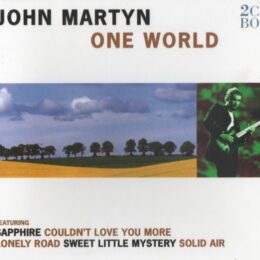
The cover is adorned with a collage depicting a rugged heather covered Scottish landscape by Cathie Felstead and the rear features a photograph taken by Anton Corbijn. Cathie attended Chelsea School of Art and studied illustration at the Royal College of Art, graduating with a Master’s degree. Now an award winning illustrator her artwork has been shown in many exhibitions in Britain and abroad. I asked Cathie how she came to design the cover, “I was commissioned to do the album by Bruno Tilley who was the art director at Island Records at the time. I think he showed John some of my work and he liked it…so that was that!”
The original piece is quite small, about 30cm square and resides on the wall at Cathie’s sisters’ home. “The brief was for a Scottish landscape done in my collage style, so I just played around with inks, prints, and bits of torn up paper until I arrived at something he liked! I had always loved John’s music so felt overwhelmed by the request to do a cover for the great man.”
John had rejected other covers and bizarrely some proposed cover artwork was lost, before Cathie’s inspired piece was selected, the subject matter being part of John’s very being.
John moved away almost entirely from acoustic guitar for Sapphire in favour of subdued electric guitar. The instrumentation is predominantly Linn drums and keyboards, a fact that some fans found hard to take many lamenting his apparent desertion of guitar.
John’s contemplative and enchanting vocal on his cover of Arlen and Harburg’s Over The Rainbow written in 1938 made it an obvious choice for a single. Over The Rainbow / Rope Soul’d (Island IS209) was released in October 1984 and gained John a new audience reaching number 17 in the charts. John recalled recording the song, “An accident. I wasn’t a great Judy Garland fan; in fact I never really liked her. I do now. We’d stuck down four more-or-less random drum tracks and thought we’d dub things onto them. Bangs, clatters, bonks, twiddles… notes. And in the course of all this I started humming Over The Rainbow, and it fitted. It’s since become something that I’m quite fond of.”
 John had a love of the old standards and had already recorded Arthur Freed and Nacio Herb Brown’s 1929 standard Singin’ In The Rain on his Bless The Weather album released in 1971 and The Glory Of Love written by Billy Hill in 1936 on Inside Out released in 1973.
The intoxicating up beat title track finds John in outstanding vocal form as he shares an experience of lost love and You Know eulogises the virtues of his loving relationship with wife Annie, “’every day I see your face, it makes this world a better place for me to be.”
“Johnny’s first hymn” Fisherman’s Dream is simply charming with a tremendous vocal from John and the funky Acid Rain features guitar and percussion against a musicscape of keyboards as John sings of his environmental concerns.
Mad Dog Days, inspired by the quarrelling production team, was one of John’s favourite songs on the album and one that he enjoyed playing live frequently dedicating it to Margaret Thatcher! The broody masterpiece Rope-Soul’d closes the album with an expansive improvised vocal from John, “I improvised the lyrics. In fact I improvised the whole thing. The Producer was going. ‘It’ll be great when you get the whole lyric on it ‘I Said, ‘I’m sorry, that’s it. You don’t really want any more do you?’ He said ‘Yes’. I tired of him. He was insisting on having more lyric, and me singing it differently. I thought, ‘Whose record is this?’ You might not be able to live it, but I certainly can. That’s when Robert Palmer entered the picture.”
John toured to sold-out venues across Europe and the UK and the music press were suitably impressed praising the album. “In an era when empty gestures of style proliferate in music, Martyn’s music speaks with an uncommon candour, intelligence and intensity. At times, the combination of guitar and synthesiser creates a sound which appears to come rolling across the stalls like a tsunami wave, pinning you to your seat… John Martyn strikes the perfect balance between virtuosity and simplicity; romance and realism, nostalgia and modernism. Put simply he is in a league of his own” wrote The Guardian and Rolling Stone declared “Sapphire comes close to grade A form.”
Although Sapphire could be described as a departure from his previous guitar orientated albums, John’s guitar playing is still evident, albeit low in the mix and sometimes treated. For some commentators the absence of easily identifiable guitar and the use of programmed drums and synthesisers are indicative of a decline in John’s recorded output. The same commentators would no doubt have preferred his music to remain firmly rooted in the previous decade but John’s primary fear was the fear of stagnation and this drove him forward.
To John nostalgia was a pitiful concept, he continually expanded his horizons, constantly refocused his creativity, undermined convention, and embraced new influences and technology. His creative restlessness was fuelled by his life experiences; he wrote and sang about love. Expressing such openness may have frightened some but not John.
There is no doubting the fine craft and quality of his song writing and his singing is superb, showcasing perfectly the dynamic range of his voice throughout the album; he was not only a superlative guitarist but also a highly accomplished singer. The seductive and melodious songs sparkle; their captivating quality, using the then latest technology, have achieved classic status amongst fans.
John’s passion for life, love and music was contagious. The severity of the contradiction between his notoriety as a wild, uncontrollable maverick who lived life on the edge and his heartfelt music could not be greater.
John was a tour de force, an original.
John Hillarby