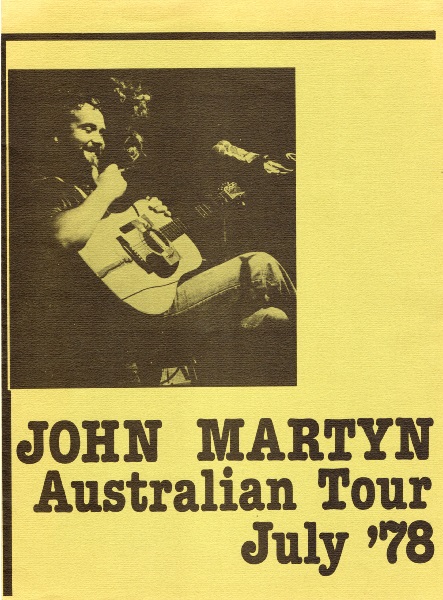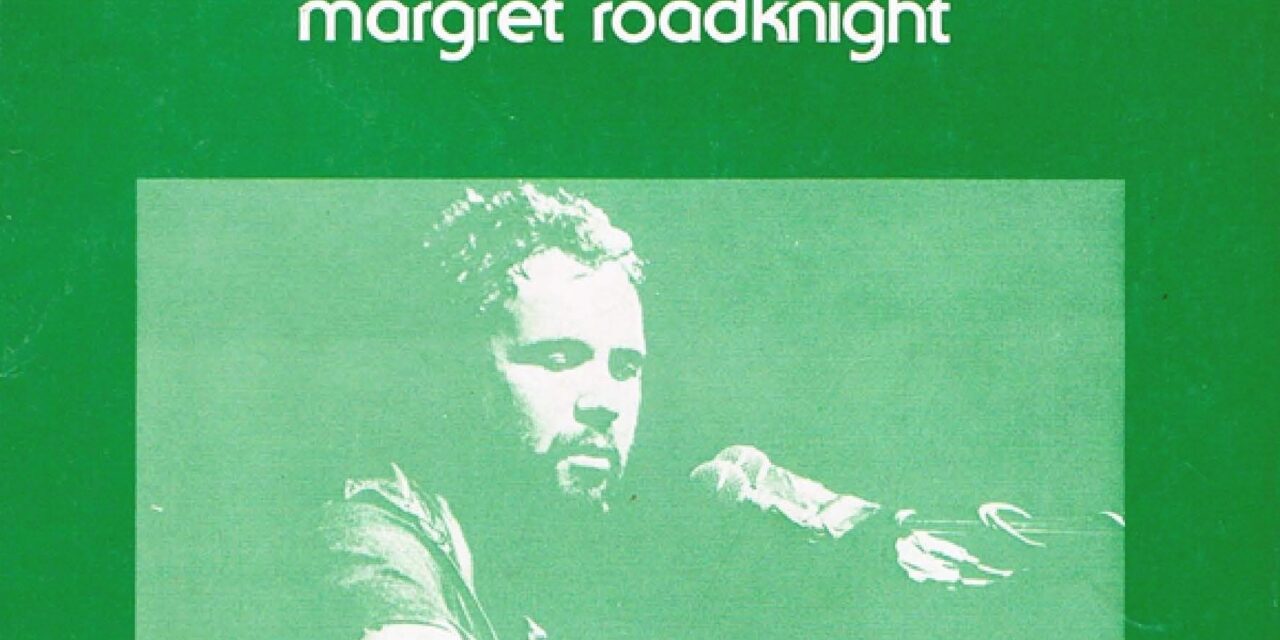
Australian Tour 1978
John Martyn was born in Glasgow and spent most of his childhood there before coming down to London when he was 17. “I learned to play off a guy called Hamish Imlach who taught me all the things I knew in C… taught me all these kind of guitar licks and the sort of stuff that Ralph McTell plays – ragtime, very gentle kind of Dylany stuff. I used to go and see him all the time. A friend of my father’s called Willie Sinnit used to make guitars and he knew I was playing guitar, so he said, ‘I know a friend called Hamish Imlach who plays in clubs and stuff.’ So he took me around to two or three clubs. Hamish did a concert close to my house once -this was when I was 16 and I’d been playing for just about three or four months- with a guy called Josh McCrae who did a song called ‘Messin’ About On The River’ (remember that one from ‘Children’s Favourites’ days?) Well he didn’t turn up so they were stuck for somebody to play for half an hour. They asked people from the audience to do a couple of songs and eventually they shoved me up there and everybody liked it. So Hamish said, ‘Why don’t you come around and do a couple of songs in my set for people and maybe earn a few quid for it.’ At that time I’d been chucked out of art school for being nasty and silly, and I didn’t have much money -I was earning my money playing darts in those days, making about two quid a day and he took me around to a lot of folk clubs. A lot of them thought it was ridiculous mind you, but Bert Jansch was just beginning. I think he had one album out and he was a very ‘underground’ hero – he smoked pot, pot and not hash I may add, and everybody listened to him.”
“So I just did loads of gigs like that. Everyone in Scotland was very in awe of the London scene… like that was the thing to do when you wanted to make it… that’s where you went. Then I listened to a Davey Graham album and that completely blew me away. I went to see him in a folk club called Cousins and I came back full of the whole thing about London. I was dossing in London, sleeping in Trafalgar Square, and getting moved on by the fuzz. I came back up and worked on a building site for a couple of weeks, couldn’t hack that, and then I met the Incredible String Band who were very much into what I was doing. They’d only just started and I would support them on little folk club gigs and get three or four quid. They told me that they were working at Cousins so I went down there and they introduced me to Andy Matthews. And I remember I just asked him and asked him and asked him and asked him for a gig. And he said ‘I’ve never heard you.’ So I said, ‘I’ve played in your club about five or six times, why haven’t you heard me?’ So he said, ‘Alright, you can do an all-nighter.’ So I did an all-nighter with Davey Graham, and that was it. Cousins is really the only London club that stands out in my mind. Not because it had a reputation, but because it was a good club. And it was the only place where you could totally relax. Also it was in Soho and that was very romantic to me when I was young… strippers and concerts and stuff… a very wide eyed thing. That relates to a song of mine called ‘Dusty’ – that wide-eyed thing. My parents were divorced when I was young and I only got to see my mother for two months of the year, and I never got to stay with her because my step father didn’t like me, so I stayed with her sister and her husband. Now they lived in Hampton Court and every year I went down it would be the Scottish school holidays which is late July, August and a bit of September, so I’d always be in Hampton Court at the time of Whitsun which was when the fair was. And that song ‘Dusty’ is just about Hampton Court Fair. ‘Cause that was my dream when I was a kid… the grass is always greener.”
“Actually, I thought I was very happy as a child because my grandmother was just beautiful to me and my father was excellent, but London was like a dream to me… even the Southern line, the green trains, and the journey from Waterloo to Surbiton – that’s where my mother lived. You see I come from Glasgow which is a very stroppy part of town and you don’t have any choice up there – either you’re violent or you’re a weed. And I haven’t got the capacity for being trodden on. I’m a natural born coward just like everybody else, but I don’t like being taken advantage of. I’m probably still the same now. But at the time it was just either eat or be eaten and it was just such a pleasant change to come down here. There were fights in in school all the time and knives were bandied about, and it always seemed more civilised to be in England, especially round the Kingston way. It was just a very civilised part of my life. I did my best in a way to become a middle-class Englishman for two or three months and then I realised that there was another side to that which was the pill-droppers who lived with their parents at night in Hinchly Wood or Esher or something but who nonetheless went out at weekends and took loads of speed and smoked a bit of grass, and went about with loose young ladies. So I was involved with that for a while. It was a very strong part of my life, a real stretcher for me because I’d led a very closed sort of existence up until then.”
If Cousins was the most memorable venue for John in those days, then the Kingston folk barge was probably the most important because it was there that a guy called Theo Johnson approached John and said, quite literally, I will make you a star! If you look at the cover of his first album, ‘London Conversation’, you’ll see a sleeve note which starts ‘So there I was on this barge on a river…’
“That’s the Kingston folk barge which was run by an alcoholic called Geoff who used to drink methylated spirits and red wine… he’s now become a traffic warden and the barge was towed away as a derelict. I was playing on the folk barge when a fat man called Theo Johnson appeared. He’d just recorded two albums of bawdy ballads for Island, because Island at first were kind of a spurious label, they used to release dirty noises and stuff called ‘Aphrodite Unleashed’ or something… any kind of record that would make money, rugby songs, anything at all that there was a small market for they’d chuck out. Anyway Theo Johnson took me up to Island with a song called ‘Fairy Tale Lullaby’ which everyone was very impressed with, and I’ve been there ever since. About three weeks after I’d signed with Island, Theo Johnson came to me and said, ‘Here’s the management contract.’ And it gave him 45% of everything I might earn for the next ten years, so I told him to stick that. And that was probably one of the best things I ever did in my life. An intuitive business decision. I’ve seen him twice, maybe three times since. He was the man who started me off on the road to whatever.”
John’s first album for Island was “London Conversation”, and it came out in 1967. There are twelve tracks, eight of which John wrote himself, and they all conform fairly rigidly to the standard folk song formula of the time. Most of them are quite clearly the songs of an innocent youth, as is implied in what he’s already said, but they’re nonetheless very pleasant, and two in particular are outstanding. ‘Back To Stay’ is a very beautiful love song with an unusual structure that sets it apart from everything else, and a sad, dreamy melody the likes of which only John Martyn and a handful of other songwriters are capable of producing. ‘Don’t Think Twice’ is in a similar vein and equally good. It’s a Dylan song of course, and it’s given a simple, soft treatment. There’s a fairly long number called ‘Rolling Home’ which is dominated by a somewhat less than dazzling piece of guitar playing, but the remainder of the album just features John on guitar and vocals, simply and clearly produced.
By the time his second album, “The Tumbler” was released (1968), he had been exposed and influenced by a variety of people who he’d met on his exploits through London’s folk scene… people like Davey Graham, Bert Jansch, and a guy called Harold McNair who played flute, on “The Tumbler.” “We recorded the album in one afternoon which is quite interesting I think. Things were very simple in those days.” The only other musicians on the album besides John and Harold McNair, were Paul Wheeler on second guitar and Dave Moses on bass.
After that came an important event in John’s career, his meeting with his wife-to-be, Beverley. When the time came for John and Beverley to make their album together they went to the States… this was 1969… and under the guidance of Joe Boyd and the musical direction of Paul Harris they cut “Stormbringer!” at A&R Studios, New York. The line-up of musicians on the album is impressive to say the least… Paul Harris – piano, organ, Harvey Brooks – bass, Levon Helm, Billy Mundi, Herbi Lovell – drums, and John Simon – harpsichord, and the music is, as one would expect, outstanding.”I enjoyed making that album a lot. That was really one of the finest hours because I think it surprised everybody. I think they were expecting some little folky album to come out and it came out with a lot of bite.”On to the fourth album, “The Road To Ruin” (1970), recorded at Sound Techniques in Chelsea with John Wood as engineer. It was the second and last album made with Beverley. Personnel for the album were Paul Harris – piano, Wells Kelly – drums, Rocky Dzidzornu – congas, Dave Pegg – bass, Alan Spencer – bass, Dudu Pukwana – sax, Lyn Dobson – flute and sax, Ray Warleigh – sax, and Danny Thompson – double bass.
“The Road To Ruin” stands apart from other John Martyn albums not least because of the way it was recorded, and also because it employs distinctly jazz instrumentation in what is basically a rock format. “Bless The Weather” (1971) is very much a reversion back to the pure, simple songs of the early days but with a considerably more mature outlook. The lyrics are stronger, the melodies very imaginative and very beautiful, and the instrumentation is for the most part kept to a basic guitar/bass/vocal line-up. Additional help is used though in the persons of Ian Whiteman and Robert Powell from the legendary Mighty Baby, Tony Reeves, Richard Thompson, Smiley De Jonnes and Beverley on the odd vocal track. “Most of the songs on “Bless The Weather” were very quick. I’d been writing songs in the studio on the day they were recorded. It’s much nicer like that – to be spontaneous. There was no re-writing, it just came out very naturally. I much prefer that approach. I suppose the logical extension of that would be to go and improvise an album but even that’s too heavy. There’s a nice happy medium in “Bless The Weather.”
Next we come to his sixth album, “Solid Air” (1973). The tracks are ‘Solid Air’, ‘Over The Hill’, ‘Don’t Want To Know’, ‘I’d Rather Be The Devil’, ‘Go Down Easy’, ‘Dreams By The Sea’, ‘May You Never’, ‘The Man In The Station’, and ‘The Easy Blues’. Every one except Skip James’ ‘I’d Rather Be The Devil’ is an original, and the musicians featured are Danny Thompson – double bass, John Bundrick – piano, organ, clarinet, Dave Mattacks – drums, Dave Pegg – bass, Speedy (Neemoy Acquaye) – congas, Tristan Fry – vibes, Tony Cox – sax, and Richard Thompson and Simon Nicol on mandolin and autoharp.”
Now ‘Solid Air’… I really like the title track. It was done for a friend of mine, and it was done right with very clear motives, and I’m very pleased with it, for varying reasons. It has got a simple message, but you’ll have to work that one out for yourself. As for my voice, I’ve always used it as another instrument, and I think it should be that. It was always my conception of a vocal. I think from now on though, when the song requires it, I’ll make a conscious effort to make the lyrics more intelligible. I used Dave Pegg and Dave Mattacks on the album because they go together. It’s always good to have a rhythm section that are used to playing with each other.”
And to the album “Inside Out” (1973) which maintains the style and diversity of its predecessor with a number of songs that compare favourably with anything he’s done. The best are a lyrically mysterious song called ‘Fine Lines’, ‘Make No Mistake’ and ‘So Much In Love With You’. There’s another illustration of sustained guitar textures in a very mellow track called ‘Eibhli Ghail Chiuin Ni Chearbhail’, and plenty of loose, almost unstructured electric guitar work that reflects Martyn’s respect and interest in the best jazz. Musicians featured this time include Danny Thompson, Remy Kabaka, Stevie Winwood, Chris Stuart, Chris Wood, Kesh Satie, Bobby Keyes, Brian Cooke, and John Wilde.It was over a year until the next album “Sunday’s Child” (1975) was recorded and the line-up included Danny Thompson (again), Liam Genochey, Toni Braunagel, Terry Wilson, Al Anderson, John Bundrick, Kesh Satie and Beverley Martyn doing vocals on one track. It’s an album consisting of love songs. ‘My Baby Girl’ for his daughter and one traditional song ‘Spencer The Rover’ with a very untraditional treatment.
The ‘Best of’ album, “So Far, So Good,” appeared in 1977 and tracks were culled from “Bless The Weather”, “Solid Air” and “Sunday’s Child.” Martyn spent eighteen months writing new material for “One World” (1978), produced by Chris Blackwell. In between “Sunday’s Child” and “One World” Martyn had been experimenting with his music working in Jamaica with such people as Lee ‘Scratch’ Perry and Jack Ruby, two of the finest reggae producers. This album consolidates all the diverse strands which have influenced Martyn’s music over the last ten years. This album is blessed with the talents of Danny Thompson, Steve Winwood, Morris Perth, Andy Newmark, John Stevens, Dave Pegg, Bruce Rowlands and, on one track, trombone player Rico.
Martyn’s early tours concentrated on Britain and North America (a tour there in league with Traffic and Free during January, 1973, created such a demand for Martyn that two headlining club tours of the U.S. were strongly anticipated. On one of them, Martyn virtually stole all the thunder from Yes when he supported their concert at Madison Square Garden). In 1977, however, following a sell-out British tour, Martyn visited Australia for the first time, a concert tour which earned rave applause from both critics and the audiences. Now he’s here for a second tour and it should be just as successful as his last.
Tour Dates
10th July 1978 – Perth Concert Hall, Perth
12th July 1978 – Opera Theatre, Adelaide
13th July 1978 – Canberra Theatre, Canberra
15th July 1978 – State Theatre, Sydney
19th July 1978 – Dallas Brooks Hall, Melbourne
Special Guest – Margret Roadknight
Special Guest Margaret Roadknight – acknowledged as Australia’s leading folk and blues singer began her career in the early 60’s singing in coffee lounges and Jazz and Folk Clubs around Melbourne. Her interest in the wide variety of music she performs was aided by performers such as Glen Tomaseti, Trevor Lucas and Martyn Wyndham-Read when she saw them at a Melbourne Folk Music Concert in 1962. Later, in 1964 she was introduced to and taught to sing gospel by the visiting Black Nativity Company.
When they came to Sydney, Margret followed and stayed a year, during which time she appeared on Leonard Teale’s “Folkmoot” and Dave Guard’s “Dave’s Place.” Up until this time Margret was only known on the Victorian scene, from her many appearances at Folk and Jazz Festivals and Clubs.
Margret became well known for her large repertoire which covered contemporary folk, black music, spirituals, gospel songs, African chants, lullabies, classic blues, jazz, calypso and madrigals. In 1967 she began lecturing on folk music with the Commonwealth Adult Education Courses, and then followed up with summer schools in folk guitar at Melbourne and Monash Universities and Fairlea Prison. She has also been a guest at workshops held by various organisations including the South Australian Theatre Company and toured Queensland for the Australian Society for Music Education. Margret also regularly toured the University and College campuses giving concerts and for several years was one of the only two foreign correspondents for the authoritative American Black Music Magazine, “Gospel News Journal.”
In 1971 Margret made her first big appearance at the Dallas Brooks Hall, Melbourne and the same year she recorded material which was later released on the album “The Odds Are Against Me” with Lazy Ade Monsbourgh and others.
Margret’s first solo album “People Get Ready” was released in 1973 – recorded live at Frank Traynor’s Folk Club… “This album achieves a high level of communication and intimacy… singing calmly and with authority, with a deep sympathy for meaning of her material.” (Music Week)
1973 also saw Margret featured on Gerald Stone’s ABC-TV Current Affairs program “Open End.” In 1974 Margret was given a grant by the Australian Council For The Arts, for a six month study tour of America. Because of the American work permit regulations, Margret could not be paid to perform and therefore could only appear by invitation. This did not however create any great problems and she was invited to appear on stage with Odetta at Max’s Kansas City (one of New York’s top Jazz Clubs), Malvina Reynolds (the 74 year old matriarch of Folk Music) and Turk Murphy’s Band in San Francisco. She also appeared at a Gospel Convention in Cleveland with the East St. Louis Gospelettes and then on to Chicago with the same group to record.
Since returning to Australia in February ’75 Margret has had a busy time, with concerts, campus tours, TV and radio appearances, not to mention the regular interstate trips to appear at venues in Brisbane, Melbourne and Adelaide. September ’75 saw the release of Margret’s first single “Girls In Our Town” – a Bob Hudson composition. This received considerable airplay around the country and charted in Melbourne.
Margret’s second album, “Margret Roadknight” recorded over a period of 2 years was released late ’76 coinciding with the signing, with Festival Records, of her first recording contract. Now comes “ICE”, Margret’s second album with Festival, recorded just prior to her departure on her second study trip to America and Europe.
With thanks to Peter Howell
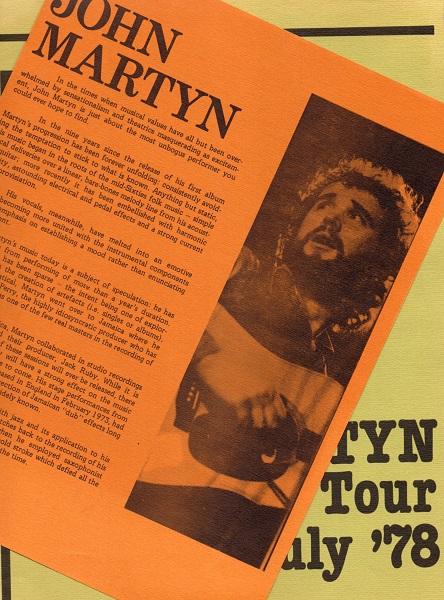
Island and Festival Records also produced a 4 page and 2 page press release to promote the tour, please see images below.